
The debate scale
Which debate are you in?
A meeting, a family dinner, a TV studio: every conversation sits in one of five states of debate. Knowing where it stands tells you what to change, in the framework as well as in behaviour.
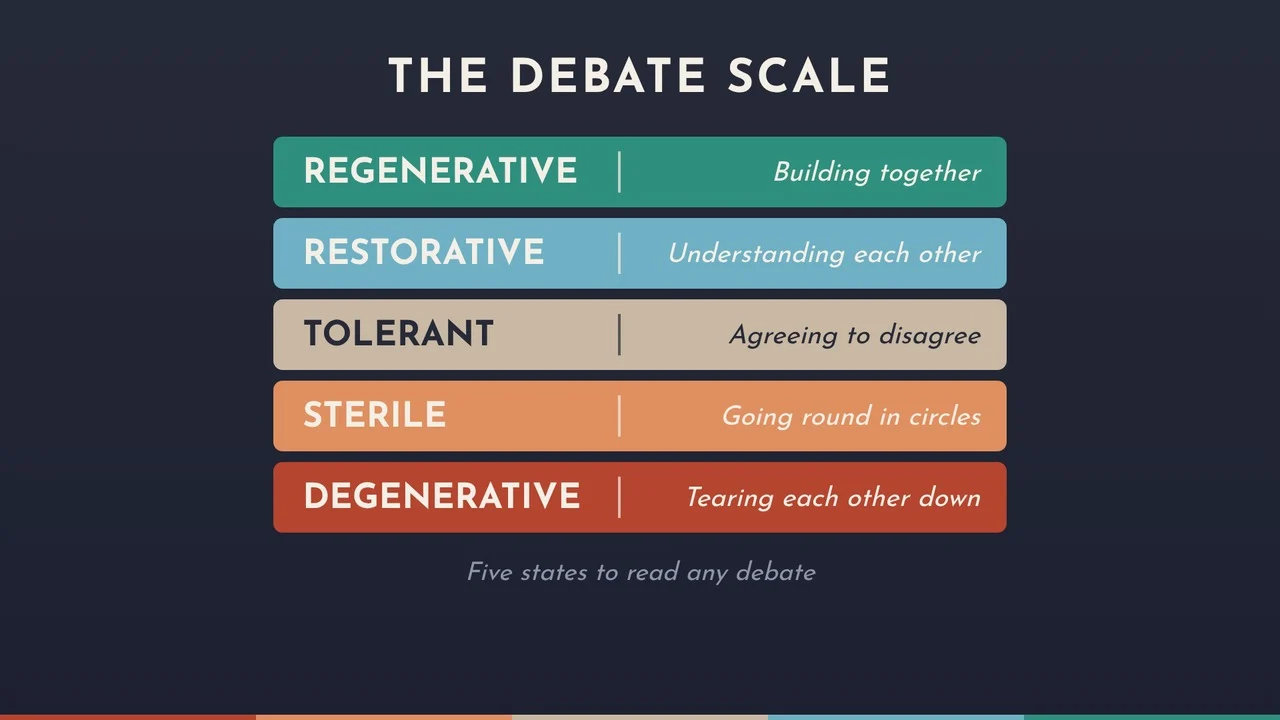
The five states of debate
Each state can be read in two ways: the ground rules that were set, and the behaviour you see. Open them up.
RegenerativeBuilding together
The ground rules
The rules were made by the people who follow them, and when one gets in the way, everyone stops to work out what comes next.
Everyone has shared their own experience, and those stories count as much as the arguments.
The behaviour
People actively try to feel what the other person is going through, which strengthens the relationship and their grasp of what is at stake.
Disagreement becomes the raw material for new ideas that every side can accept.
In everyday life
“We don’t see it the same way. What could we build out of both our views?”
In politics
“On the whole, Sir, I cannot help expressing a wish that every member of the Convention who may still have objections to it, would with me, on this occasion, doubt a little of his own infallibility, and to make manifest our unanimity, put his name to this instrument.”
Benjamin Franklin, read aloud on his behalf on the last day of the Constitutional Convention, Philadelphia, 17 September 1787. He admits he does not approve of every part of the text, and invites those who still object to sign it with him. Thirty-nine delegates signed that day.
RestorativeUnderstanding each other
The ground rules
The group said at the outset what it wanted to achieve together, and set rules to get there.
Everyone had their turn to speak, nobody was cut off, and what was said was taken seriously.
The behaviour
You restate the other person’s position and wait for them to confirm before you object.
You hold on to your disagreement while recognising that the other person’s view is valid, even if incomplete.
In everyday life
“If I understand you, what matters most to you is… Is that right?”
In politics
“No, ma’am. He’s a decent family man, citizen, that I just happen to have disagreements with on fundamental issues, and that’s what this campaign’s all about.”
John McCain, taking the microphone back from one of his own supporters who had just called Barack Obama untrustworthy and “an Arab”. Lakeville, Minnesota, 10 October 2008.
TolerantAgreeing to disagree
The ground rules
A frame of mutual respect is set and kept.
Each person sets out their whole position, and the next one starts as if nothing had been said.
The behaviour
You listen politely to the end, then bring out exactly the argument you had prepared.
Touchy subjects get sidestepped: everyone leaves without being offended, and without having really dealt with the issue.
In everyday life
“I respect your point of view. But I’m still convinced I’m right.”
In politics
“I subscribe completely to the spirit that Senator Kennedy has expressed tonight, the spirit that the United States should move ahead. Where then do we disagree?”
Richard Nixon, first televised presidential debate, Chicago, 26 September 1960. He grants his opponent the goal with real courtesy, then spends the evening defending the means he came in with.
SterileGoing round in circles
The ground rules
Each side demands a rigour from the other that it doesn’t apply to itself.
The format of the exchange is just a pretext to push one’s own ideas.
The behaviour
You answer a simplified version of what the other person said, and they spend their time correcting you.
In the end someone gives up just to make it stop, without having changed their mind an inch.
In everyday life
“So, if I follow you, everything I say is wrong?”
In politics
Dan Quayle: “I have as much experience in the Congress as Jack Kennedy did when he sought the presidency.”
Lloyd Bentsen: “Senator, I served with Jack Kennedy. I knew Jack Kennedy. Jack Kennedy was a friend of mine. Senator, you’re no Jack Kennedy.”
Vice-presidential debate, Omaha, 5 October 1988. The line brought the house down and is still quoted today. The question the moderators kept asking, whether Quayle was ready to be president, never got a real answer.
DegenerativeTearing each other down
The ground rules
There is no rule both sides accept, and anyone who invokes one is treated as a cheat.
The goal is to dominate the opponent, and the end justifies the means.
The behaviour
You attack who the other person is rather than what they say.
You look for the one-liner that will crush your opponent.
In everyday life
“There’s no point talking with people like you.”
In politics
Hillary Clinton: “It’s just awfully good that someone with the temperament of Donald Trump is not in charge of the law in our country.”
Donald Trump: “Because you’d be in jail.”
Second presidential debate, St. Louis, 9 October 2016. Minutes earlier, Trump had promised a special prosecutor to investigate his opponent. The adversary is no longer someone to convince but someone to lock up.
Which argument leads to which debate?
Each state of debate has its own kind of argument. Spotting the one in play tells you which debate you are in.
Degenerative
The shadow man
You attribute hidden motives to the other person, and respond to those motives rather than to their arguments.
Its variants
- Generalizing the extreme: pinning the position of the most radical members on the whole opposing camp.
- Assuming the worst motive: explaining the other person’s view by the most shameful reason imaginable.
- The slippery slope: presenting the other view as the first step towards disaster (“that’s how it starts…”).
- Reducing to a label: “the woke”, “the fascists”: the label spares you from listening to what the person says.
- Raising the threat: casting the other camp as a danger, to rally your own.
Sterile
The straw man
You caricature the other person’s position so it is easier to knock down.
Its variants
- Exaggerating: stretching what the other person said to the point of absurdity.
- All or nothing: turning a nuance into an absolute position.
- The weakest link: answering the weakest argument and ignoring the rest.
- The question next door: answering a nearby, easier question.
- The false restatement: “So if I follow you…”, followed by something they never said.
Tolerant
The steel man
You rebuild the strongest version of the opposing argument before answering it.
Its variants
- Restating until they agree: rephrasing their position until they say “yes, that’s exactly it”.
- Completing their case: bringing the best argument for their side, even if they didn’t make it.
- Aiming at the idea: answering the best-defended version of the idea rather than the way it was put.
Restorative
The silk man
You restate your own position in terms of the other person’s moral values, or of something they have lived through: this is moral re.framing.
Its variants
- Speaking their values: translating your position into the other person’s moral values: care, fairness, loyalty, authority, sanctity, liberty.
- Taking on their definitions: using words in the sense the other person gives them, rather than arguing over what they mean.
- Starting from their experience: building on something they have lived through.
- Starting from their intuitions: building on an image or an idea that already speaks to them.
- Finding the shared value: grounding your position in a value both sides hold.
Regenerative
The synthesis man
You hold the strongest version of each side together and name the real trade-offs, without erasing any of them.
Its variants
- Acknowledging the fair point: saying what is true in the other person’s position.
- Naming your own limit: pointing out what your own view leaves aside.
- Telling a third story: proposing a formulation that brings together the views of every party.
- Combining every position: looking beyond the camps that are speaking, to every possible position on the topic, and integrating them: this is ideological combination.
Your turn
Three lines, one situation. Place the conversation on the scale, then see what a single sentence can change.
Pick a situation
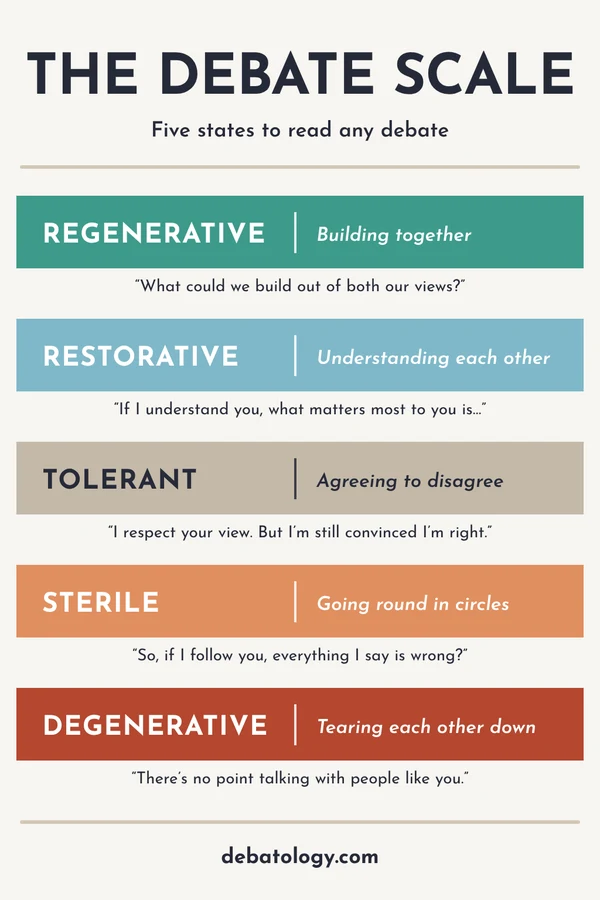
Keep it at hand
The debate scale card
All five states of debate on a single page, to print or put on screen in a meeting.
Download (PDF)What about you?
What kind of debater are you?
28 questions to find out which dimension to work on first.
Take the test